≈1,200 SKUsSix-horizon system
Delivered forecasting and inventory/procurement planning across six non-overlapping 30-day horizons for a changing portfolio of approximately 1,200 SKUs.
View evidence: Six-horizon system →Dr Mohammad Abdollahi · Data Scientist & Operational Researcher
I design and deliver forecasting and optimisation systems for what to order, what to charge and where to deliver when demand is uncertain.
Evidence: 30-month industry KTP · published doctoral research · 6th / 180+ public competition
Observed demand informs a forecast; uncertainty and operational constraints shape the order a buyer reviews.
The white line is invented past demand. Its variation matters because one number cannot describe every future week.
The teal range widens further into the future. It explains uncertainty; it is not a calibrated interval or project result.
The amber window marks a hypothetical supplier lead time. Stock on hand, incoming stock and supplier rules also affect replenishment.
The output is a proposed order for human review. The synthetic demo shows an inspectable example calculation.
 Priory Direct KTP · Data Scientist · 2024–2026
 University of Kent KTP · 2024–2026
 University of Essex PhD · Teaching support
 K. N. Toosi University of Technology MSc Artificial Intelligence
 Payame Noor University BSc Software Engineering
 Pooyesh Higher Education Institute Lecturer · 2012–2014
 Services Centre of Qom Islamic Seminary AI/NLP research · 2013–2020
01 / Evidence
Delivered forecasting and inventory/procurement planning across six non-overlapping 30-day horizons for a changing portfolio of approximately 1,200 SKUs.
View evidence: Six-horizon system →One February 2026 retrospective origin: 1,069 SKUs, H1–H6, versus an earlier pipeline configuration; gains were concentrated, not universal.
View evidence: Less aggregate absolute error →Placed sixth of 180+ participants in the Global Forecasting & Inventory Planning Competition, separate from the KTP.
View evidence: VN2 competition · 2025 →Forecast-informed pricing and routing research using Ocado data; simulated improvements in studied settings, not realised operational profit.
View evidence: Simulated profit improvement →System delivery, retrospective evaluation, competition ranking and simulated research results represent different kinds of evidence. Forecast-error reductions do not establish realised stock or cost savings.
02 / Application
Industry delivery · KTP
Delivered forecasting across six non-overlapping 30-day horizons, connected to inventory policies and supplier-constrained purchasing for approximately 1,200 SKUs.
Approximately 1,200 SKUs · Priory Direct / University of Kent · 2024–2026
Read the case study: From demand forecasts to procurement decisions →Public competition
Sixth of 180+ participants in the first public inventory-planning competition (2025). Six weekly ordering rounds, two-week lead time, scored on holding and shortage cost. Only 25 entries beat the organiser's benchmark.
6th place · independently scored
Organiser's results →Doctoral research
Developed forecast-informed pricing, slotting and routing methods for online grocery delivery; simulated profit improvements of 13.57–21.43% in simulations using real-world Ocado data.
13.57–21.43% simulated · EJOR 2023, Annals of OR 2026
Read the case study: Using forecast demand to improve delivery decisions →Technical Lab
Interactive examples in forecasting, inventory optimisation and operational research. They are synthetic demonstrations, separate from the evidence above.
Forecasting
Seasonal naive, recursive and direct forecasts for H1–H6, scored on chronological origins.
Open example: Multi-step forecasting →Inventory
From a coverage target and a lead time to a pack-rounded order, using the demo’s calculation.
Open example: Forecast to inventory →Optimisation
One depot, one vehicle and eight synthetic customers. Exhaustive search, with capacity and delivery windows.
Open example: Single-vehicle routing with time windows →03 / Method
04 / Research
Online grocers must decide which delivery slots to offer and at what price while orders are still arriving. This paper estimates the opportunity cost of each slot more accurately by routing forecast orders alongside confirmed ones, and introduces a dynamic slot-combination strategy that uses customers’ flexibility to make routes more efficient. Both ideas work within standard time-window routing systems and are evaluated in simulations using real-world data.
When a customer books a delivery slot, the retailer does not yet know which other orders will arrive. This paper forecasts the orders still to come and includes them in a dynamic routing model, so that slot availability and delivery charges reflect the true cost of each booking. The approach is tested on real-world attended-home-delivery data.
I have taught and supported teaching in artificial intelligence, machine learning, statistics and programming at undergraduate and postgraduate level, at the University of Essex and earlier as a Lecturer in Computer Science. I combine concise explanation with worked examples and coding activities, and adapt for students from different disciplinary backgrounds.
Teaching experience and a sample exercise →Revising the KTP forecasting manuscript for multi-horizon evaluation and a doctoral paper on opportunity-cost estimation. I am also developing ForecastOps, an independent private platform validated with synthetic scale exercises and PostgreSQL staging; it is not enterprise deployed.
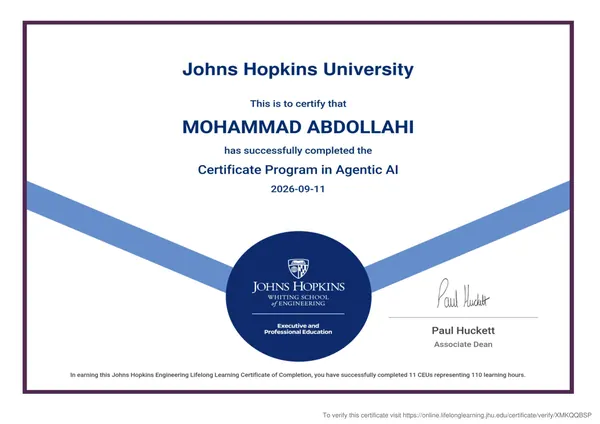
I completed the Johns Hopkins University / Great Learning Certificate Program in Agentic AI on 11 September 2026, following the Udemy MLOps bootcamp in April 2026. These courses support my development in ML engineering and agentic AI.
Full background →If you are hiring for data science, forecasting or optimisation roles, exploring a research collaboration, or have a forecasting or inventory problem you would like a second opinion on, send me a short note.